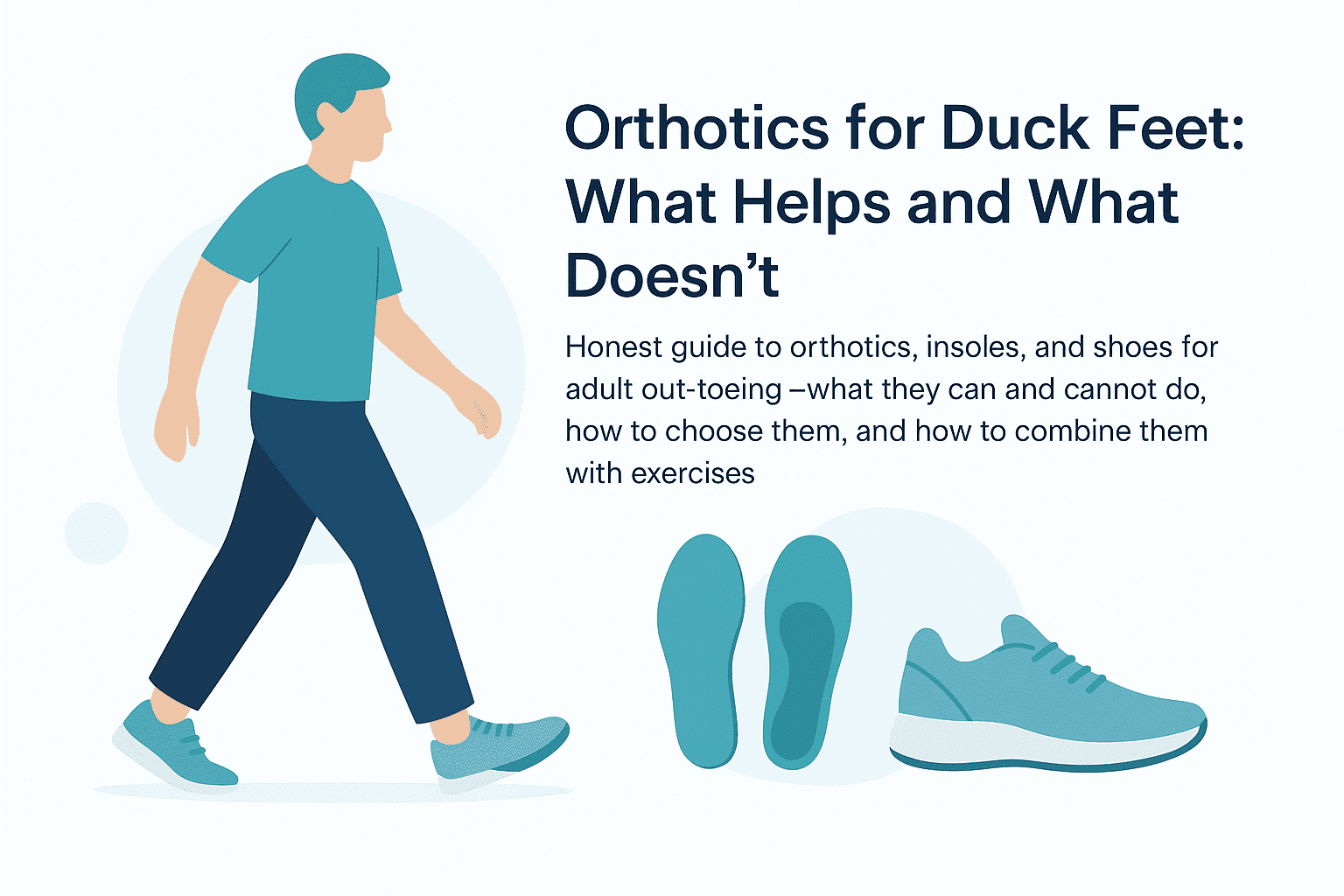
Orthotics and insoles do not “fix” out-toeing that comes from femoral or tibial torsion. What they can do is reduce excessive foot pronation, redistribute pressure, and improve comfort so walking feels steadier. For many adults, the best results come from combining supportive footwear and selectively chosen insoles with mobility, strength, and light gait retraining.
If pain is persistent, the pattern changed suddenly, balance is worsening, or neurologic signs appear (numbness, weakness, coordination changes), seek professional evaluation promptly.
What orthotics can and cannot do for out-toeing
Out-toeing (“duck feet”) describes a foot progression angle that points outward during walking. The visible angle can come from several places:
- Hip and femur orientation (femoral version)
- Tibial alignment (tibial torsion)
- Foot and ankle mechanics (mobility, pronation/supination control)
- Habitual movement and footwear history
Here’s the honest scope of orthotics:
- They do not change femoral or tibial torsion. Those are structural tendencies.
- They can reduce excessive foot pronation for some people, which may make steps feel more controlled.
- They can redistribute pressure to ease hot spots or help plantar tissues feel better supported.
- They can complement exercises and gait practice by making repetitions more comfortable.
- They do not replace mobility, strength, or walking practice when those are the active limits.
When orthotics are more likely to help
- You notice collapsing inward through the arch/ankle (pronation) with fatigue.
- Your foot gets sore with longer walks, but feels better in firmer, more supportive shoes.
- You have a history of plantar discomfort or forefoot pressure that improves with a different insole.
- You can walk better with a bit more arch contour and a stable heel cup.
When orthotics are less likely to help
- Your main contributor is femoral or tibial torsion, not foot mechanics.
- You have no foot/arch discomfort and your shoes already provide excellent support.
- You expect a visible “straightening” of foot angle purely from an insert.
Types of orthotics and insoles (and how to choose)
You’ll see three broad categories in stores and clinics:
-
Over-the-counter (OTC) insoles
- Best for: mild-to-moderate pronation, pressure relief, and comfort tuning.
- What to look for: moderate arch contour, firm heel cup, torsionally firm platform (not floppy), and a shape that matches your foot.
- Pros: affordable, easy to trial and swap.
- Cons: may compress over time; not tailored to unique foot shapes.
-
Semi-custom or heat-moldable inserts
- Best for: people between OTC and true custom who want more contour or better fit inside specific shoes.
- Pros: more personalized feel; can be adjusted in clinic.
- Cons: pricier than OTC; fit depends on the clinician’s technique and the shoe volume.
-
Custom orthotics (prescribed)
- Best for: persistent symptoms, unusual foot shapes, or specific pressure-relief needs that didn’t respond to quality OTC trials.
- Pros: tailored geometry and materials; can target pressure exactly.
- Cons: highest cost; still won’t change torsion; often requires follow-up tweaks.
Practical buying checklist (OTC and semi-custom)
- Fit the shoe first: choose the footwear model you’ll use most, then test inserts inside that shoe.
- Arch contour should meet your arch—not poke or collapse away.
- Heel cup should feel snug and resist rolling inward.
- The insert should not crowd the forefoot or lift your heel so much that the shoe slips.
- Walk 5–10 minutes in-store if allowed; compare with and without the insert.
- Trial period: plan 2–4 weeks of normal-use A/B testing before deciding.
Shoes for out-toeing: features that matter
Even the best insole can’t compensate for a flimsy shoe. Start with supportive footwear, then layer insoles if needed.
Key shoe features:
- Stable heel counter: the back of the shoe should resist collapse when pinched.
- Torsionally firm midsole: the shoe shouldn’t twist easily through the arch.
- Forefoot flex only where your toes bend: avoid shoes that fold in the middle.
- Adequate toe box: your toes should spread without friction or pressure.
- Appropriate stack/rocker for your needs: slightly rockered soles can smooth rollover if ankle motion is limited.
- Secure midfoot lockdown: laces or straps that keep your foot centered on the platform.
If you’re currently using a very soft or overly flexible shoe, simply switching to a more supportive model may reduce discomfort without any insert.
Pairing shoes and insoles
- Match support levels: a firm insert in a flimsy shoe can feel unstable; a mild insert in a firm, stable shoe often feels balanced.
- Check volume: some supportive shoes already include a thick insole; swapping for a thinner insert may preserve fit.
- Reassess after a few walks: minor lace adjustments often solve “hot spots” introduced by new inserts.
How orthotics fit into a complete plan
For many adults, the winning formula is: supportive shoes + targeted insoles (if needed) + simple exercise + light gait practice.
Exercises that pair well with orthotics
- Hip rotation mobility (internal/external) to free available range
- Ankle dorsiflexion mobility for smoother forward progression
- Single-leg balance and step-down control to improve foot pressure management
- Split-stance strength to carry changes into daily movement
See examples and structure here:
- Duck Feet Exercises for Adults
- How to Fix Duck Feet Posture
- Physical Therapy for Out-Toeing in Adults
Gait practice (without overthinking every step)
- Walk at a relaxed pace for 1–3 minutes focusing on smooth, quiet foot placement.
- Don’t force your feet to point straight all day; instead, revisit posture and foot placement briefly and frequently.
- Track how you feel the next day (comfort, steadiness, tolerance) to judge whether practice is helping.
When to see a podiatrist or physical therapist
Professional evaluation adds clarity when:
- Pain persists or worsens despite footwear/insert changes.
- Gait changes suddenly, or balance feels less reliable.
- One side behaves very differently from the other (asymmetry grows).
- Neurologic symptoms appear (numbness, weakness, coordination changes).
What to expect at an appointment:
- Assessment of hip and tibial alignment, ankle mobility, and foot pressure patterns.
- Review of footwear history and current shoe wear.
- Discussion of activity volume, surfaces, and triggers.
- Prioritized plan: footwear/insoles, mobility/strength, and brief gait homework.
A step-by-step selection process (2–4 weeks)
-
Start with shoes
- Shortlist two supportive models (stable heel counter, firm torsional feel, roomy toe box).
- Walk-test both for comfort and control. Keep the winner.
-
Add an insole trial if needed
- Choose a neutral-to-stability insert that matches your arch shape.
- Check heel hold, arch contact, and forefoot room.
- Walk daily for 10–20 minutes; compare comfort and next-day feel.
-
Tune your exercises (3–4 sessions/week)
- Mobility: hip rotation + ankle dorsiflexion.
- Control: single-leg balance, step-downs.
- Strength: split-stance lifts within comfortable ranges.
-
Reassess at the end of week 2 and 4
- Questions to ask: Is walking more comfortable? Do I feel steadier? Are stairs/longer walks easier?
- If yes, continue and progress volume slowly. If not, consider a different insole, shoe, or professional evaluation.
Common mistakes to avoid
- Expecting an insert to visually “straighten” feet when the driver is torsion.
- Using very soft, unsupportive shoes underneath a firm insert.
- Skipping exercise and gait practice entirely.
- Changing too many variables at once (can hide what’s actually helping).
- Giving up before a fair trial (2–4 weeks of consistent use).
Frequently asked questions
Do orthotics fix out-toeing in adults?
No. Orthotics don’t change femoral or tibial torsion. They may help foot mechanics and comfort but won’t “correct” structural version or torsion.
What are the best insoles for out-toeing?
There is no single “best.” If you pronate, a neutral-to-stability insert with a firm heel cup and moderate arch contour is a good starting point. If you don’t pronate much, a low-profile insert that simply improves comfort may be enough.
Are shoes or insoles more important?
Shoes first. A stable, supportive shoe solves many problems by itself. Add an insole only if you still need comfort or pressure relief.
Can I just do exercises instead?
Sometimes. Exercises address mobility and control; orthotics add comfort and pressure management. Many adults benefit from a combined approach.
When should I see a clinician?
If pain persists, gait changes suddenly, balance worsens, asymmetry grows, or neurologic symptoms appear—see a podiatrist or physical therapist.
Related reading
Digital Guide
Want a practical visual framework?
Explore The Duck Feet Guide for educational visuals, practical context, and clearer next-step decisions.
Get the GuideReferences
Educational content only. This article is not a substitute for professional medical advice, diagnosis, or treatment.
Related Articles
walking
Physical Therapy for Out-Toeing in Adults
Direct overview of PT for out-toeing: assessment, exercise focus, gait retraining, and when to seek care.
Read More
walking
When Is Out-Toeing a Problem? Practical Warning Signs
Learn practical warning signs that suggest out-toeing should be evaluated by a qualified healthcare professional.
Read More