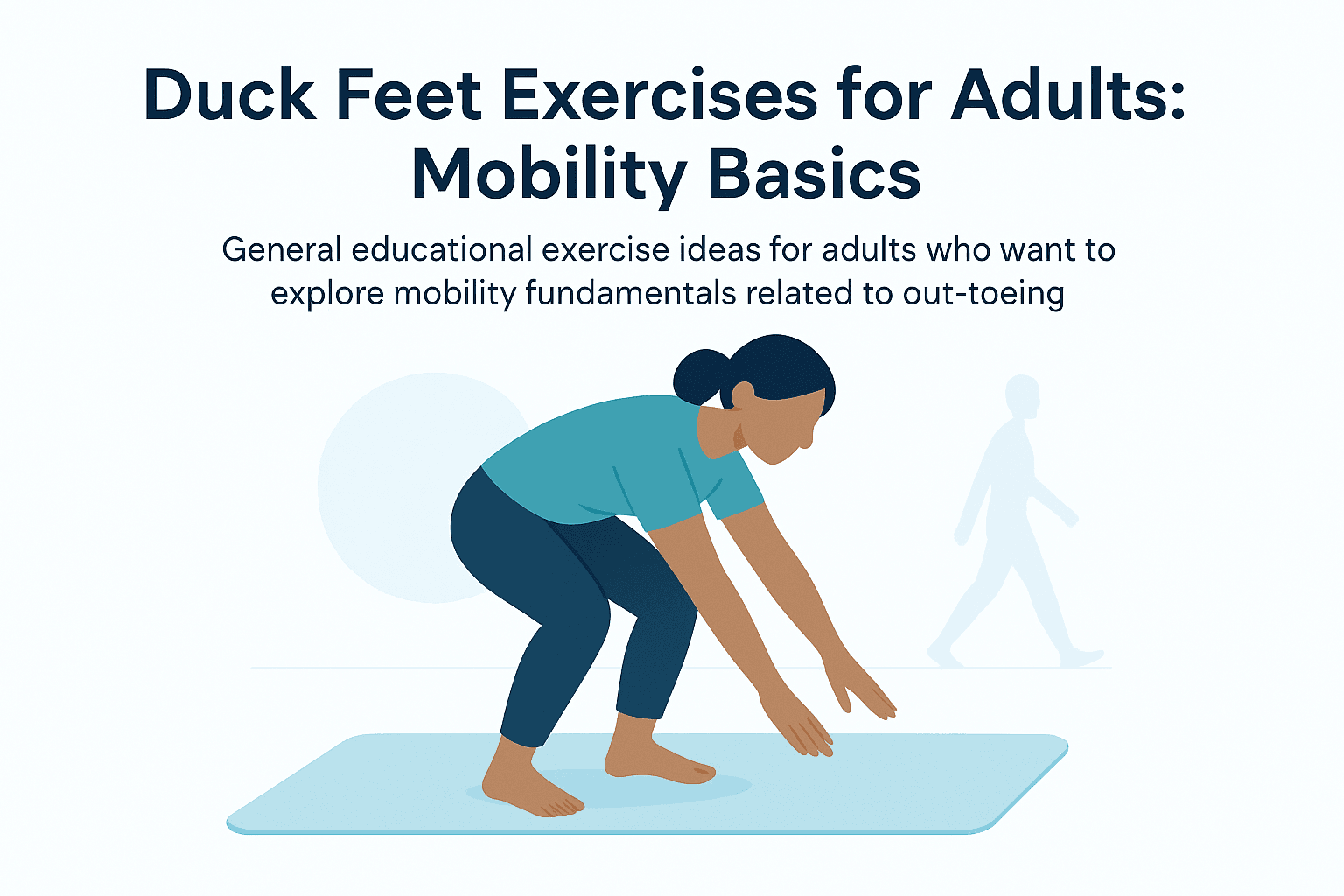
Exercises can support body awareness and movement quality, but they are not one-size-fits-all solutions. Use educational examples as a starting point.
Before you start: safety rules
- Move within comfortable ranges and smooth control.
- Mild effort is fine; sharp or escalating pain is not.
- Track response after 24 hours, not just during the set.
- Progress slowly: quality first, volume second.
A practical exercise framework (20-30 minutes)
Use this 3-4 days per week for 4 weeks as an educational starter plan.
Block 1: Mobility prep (5-8 minutes)
Hip Rotation Mobility
Focus: Internal/external hip rotation awareness
Ankle Mobility Pulse
Focus: Ankle dorsiflexion and controlled range
Block 2: Control and alignment (8-10 minutes)
Foot Tripod + Balance Hold
Focus: Foot pressure control and stance stability
Step-Down Patterning
Focus: Hip-knee-foot coordination in functional movement
Block 3: Strength and carryover (8-12 minutes)
Split-Stance Strength
Focus: Hip and leg capacity for gait support
How to progress over 4 weeks
- Week 1: learn movement and maintain low volume.
- Week 2: add 1 set to one exercise block.
- Week 3: increase time-under-tension (slower tempo).
- Week 4: increase complexity (single-leg balance challenge, controlled step height).
If symptoms worsen, reduce volume first before stopping everything.
Weekly review checklist
- Did pain decrease, stay stable, or increase?
- Is walking confidence improving?
- Are stairs and longer walks easier?
- Is one side consistently more limited?
Use this data to decide if self-management is helping or if you need assessment.
When self-guided exercise is not enough
Professional care is usually a better next step when:
- pain remains persistent,
- asymmetry increases,
- functional capacity drops despite consistent work.
Digital Guide
Want a practical visual framework?
Explore The Duck Feet Guide for educational visuals, practical context, and clearer next-step decisions.
Go to the GuideEducational content only. This article is not a substitute for professional medical advice, diagnosis, or treatment.
Related Articles
exercises
How to Fix Duck Feet Posture
A practical step-by-step approach for adults who want to improve duck feet posture through mobility, strength, and walking habit changes.
Read More