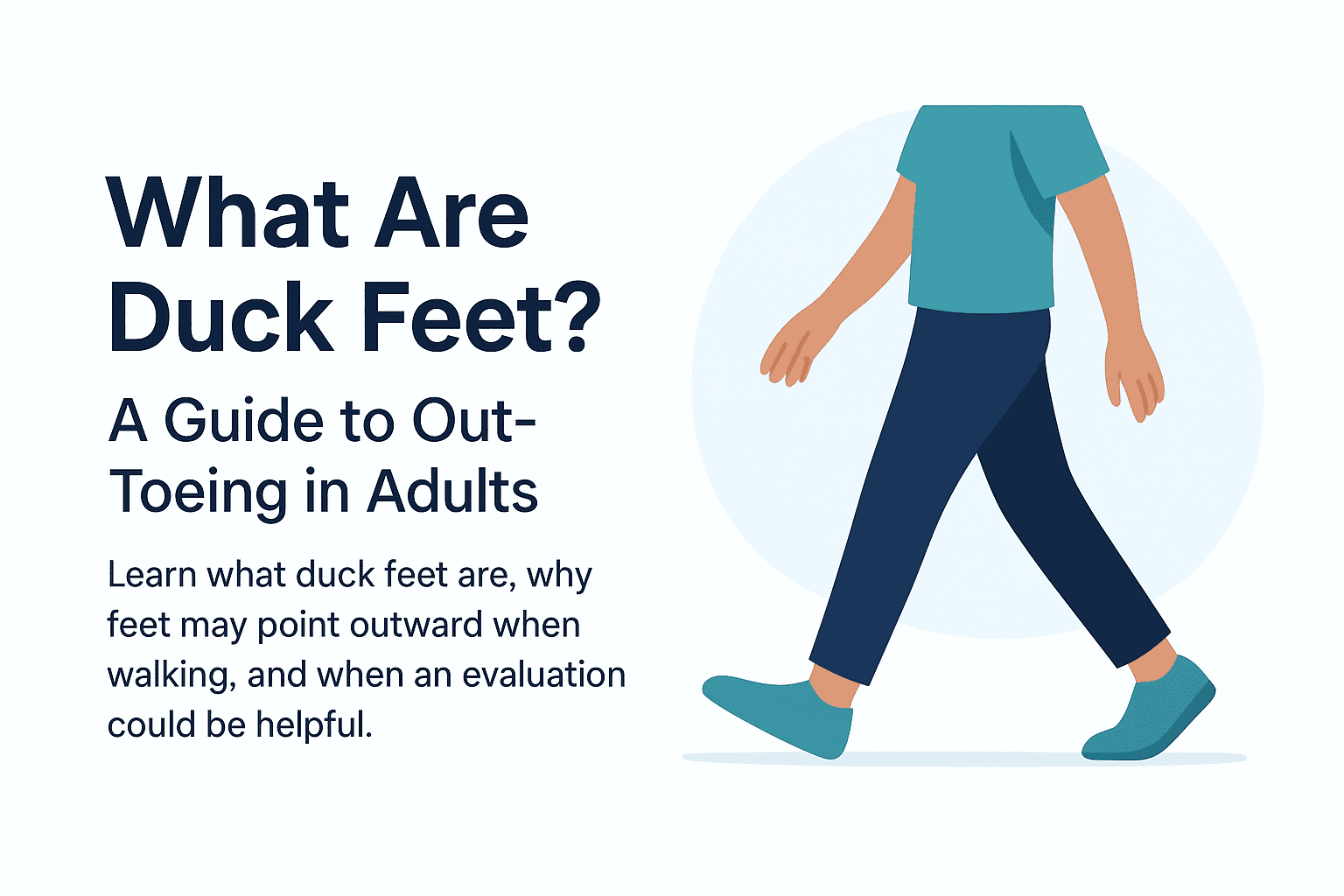
Out-toeing, often called "duck feet," describes a walking pattern where one or both feet point outward. This pattern can appear in different degrees and does not automatically mean something is wrong.
Why this guide matters
Many adults notice their feet point outward and immediately wonder: "Is this bad?" The most useful first step is to separate pattern from problem. Out-toeing is a pattern. Whether it is a problem depends on symptoms, function, and context.
What out-toeing can look like in real life
- You notice your shoes wear more on one edge.
- Friends or family point out your feet angle.
- You feel fine, but your gait looks different in photos/video.
- You have discomfort after long walks, stairs, or training.
If you have no pain or functional limitation, out-toeing can be a long-standing individual variation. If symptoms are new or worsening, evaluation is more relevant.
Common contributors (not one single cause)
Out-toeing usually reflects a combination of factors:
- Hip and femur orientation: structural and rotational tendencies.
- Tibia and knee alignment: how the lower leg tracks.
- Ankle and foot mechanics: mobility and control patterns.
- Movement habits: years of adaptation to work, sport, injury, footwear, or inactivity.
| Item | Details |
|---|
A practical 7-day self-observation protocol
Use this as education, not diagnosis:
Day 1-2: Baseline notes
- Where do you notice out-toeing most (walking, stairs, standing)?
- Is it one side or both?
- Do you feel pain, stiffness, fatigue, or instability?
Day 3-5: Trigger mapping
- Track what increases symptoms (distance, speed, shoes, surfaces).
- Track what reduces symptoms (rest, mobility, lower volume).
Day 6-7: Function check
- Compare "good days" vs "bad days."
- Note daily function: walking tolerance, stairs, work tasks, exercise comfort.
At the end, you should have clearer information for a clinician instead of guesswork.
What to avoid
- Avoid trying to force your feet into one position all day.
- Avoid copying random "corrective drills" without symptom tracking.
- Avoid assuming structural changes from internet videos alone.
When to get evaluated
Bring this to your appointment
- Your 7-day notes (triggers, symptoms, function).
- History of injuries and activity level.
- Footwear patterns and training/work load.
- Questions: "What likely contributes most in my case?" and "What should I monitor over the next 4-8 weeks?"
Digital Guide
Want a practical visual framework?
Explore The Duck Feet Guide for educational visuals, practical context, and clearer next-step decisions.
Go to the GuideEducational content only. This article is not a substitute for professional medical advice, diagnosis, or treatment.
Related Articles
causes
Why Do My Feet Point Outward? Common Out-Toeing Factors
Explore common reasons feet may point outward in adults and how multiple factors can interact.
Read More