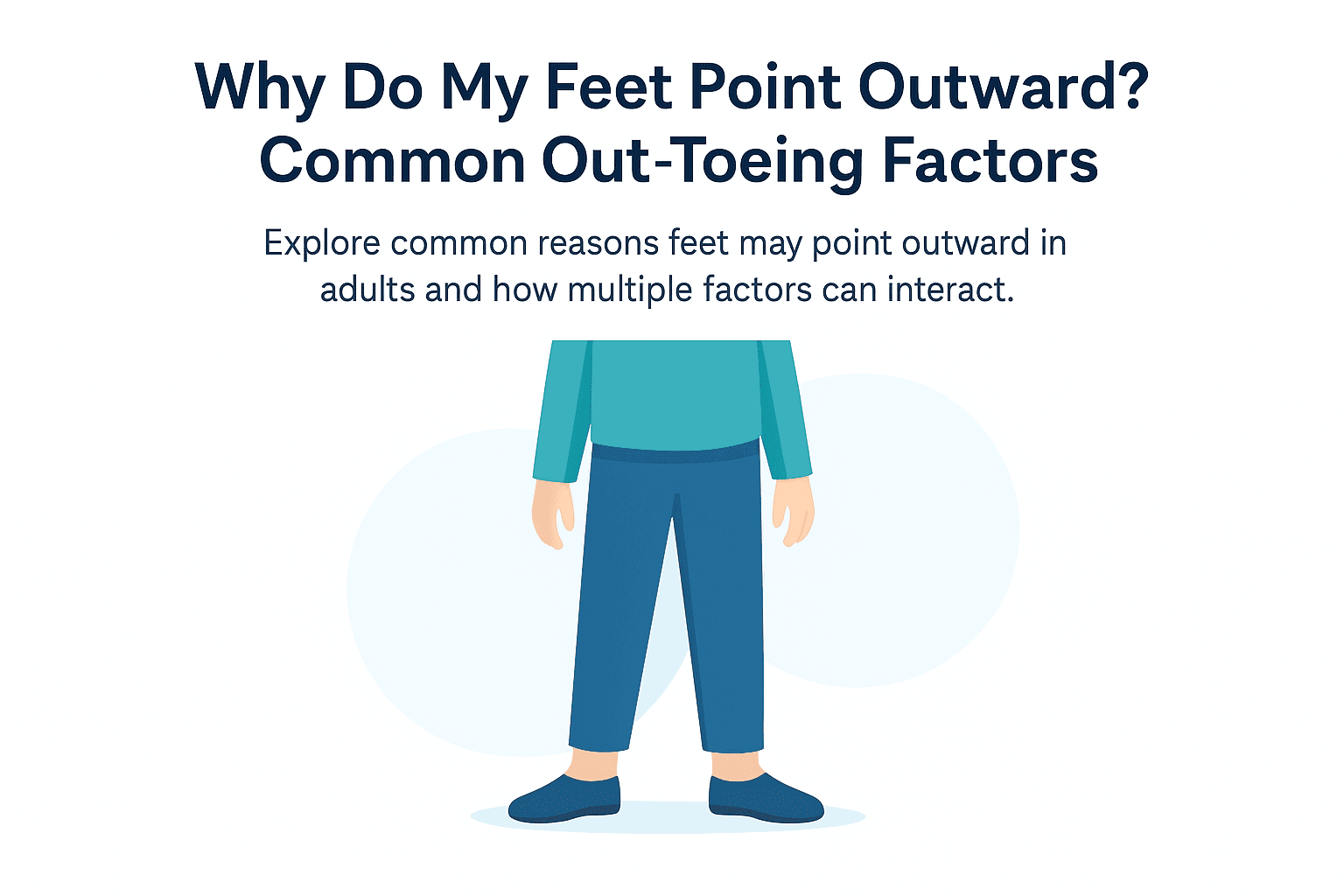
Out-toeing can have more than one contributor. It is usually more helpful to think in terms of movement patterns than a single cause.
The "single-cause" myth
Most adults do not have one simple explanation. Out-toeing is often an interaction between:
- Structure (how joints are built),
- Mobility (what ranges are available),
- Control (how movement is coordinated),
- Load (work, sport, fatigue, training errors).
Factor map: upstream to downstream
1) Hip and pelvis influence
Hip rotation capacity and control can shift leg orientation during stance and swing phases of gait.
2) Knee and tibia tracking
Lower-leg orientation can change foot progression angle even if the foot itself is not the main issue.
3) Ankle-foot mechanics
Foot posture, ankle mobility, and arch control can alter how the foot points during walking.
4) Habitual strategy
Past injury, pain-avoidance patterns, and years of compensation may make out-toeing the "default movement solution."
Practical classification for adults
| Item | Details |
|---|
14-day self-check framework
Use a simple notes app or table:
- Symptom score (0-10) after walking and stairs.
- Daily load: distance, pace, standing time, workouts.
- Footwear used: model/type and context.
- Recovery markers: stiffness next morning, fatigue, confidence.
After 2 weeks, patterns are usually clearer than day-by-day impressions.
Decision guide: monitor vs evaluate
- Monitor and continue self-management if:
- symptoms are mild and stable,
- function is good,
- no progressive changes.
- Book evaluation if:
- pain persists beyond several weeks,
- function declines (stairs, walks, training),
- asymmetry or instability increases.
What not to do
- Do not force "perfectly straight" feet at all times.
- Do not overcorrect with aggressive stretching without control work.
- Do not equate visual asymmetry with immediate pathology.
Digital Guide
Want a practical visual framework?
Explore The Duck Feet Guide for educational visuals, practical context, and clearer next-step decisions.
Go to the GuideEducational content only. This article is not a substitute for professional medical advice, diagnosis, or treatment.
Related Articles
causes
What Are Duck Feet? A Guide to Out-Toeing in Adults
Learn what duck feet are, why feet may point outward when walking, and when an evaluation could be helpful.
Read More